
Deutsche Bank presents future strategic aspirations
Deutsche Bank has announced its strategic and financial aspirations for 2015 and beyond, setting the course to become the leading client-centric global universal bank.
The plan, "Strategy 2015+", spells out how the bank will address the near-term challenges in the changed business environment and positions it to seize the opportunities presented by longer-term mega trends.
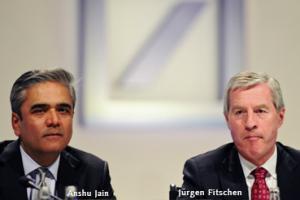
Jürgen Fitschen and Anshu Jain launched a 100-day review of the corporate strategy when they became Co-Chairmen of the Management Board and the Group Executive Committee on June 1. Following an intensive period of inclusive dialogue with stakeholders, Strategy 2015+ addresses not only the further development of a sustainable business model, but also includes a commitment to a fundamental change in the Bank's culture.
With Strategy 2015+, Deutsche Bank reaffirms its commitment to the universal banking model, its home market of Germany and its global footprint; addresses the need for further deleveraging, organic capital growth and operational excellence; and positions itself at the forefront of cultural change in the banking industry.
The bank believes that its four business pillars are ideally placed to balance its earnings mix and to satisfy increasingly complex and global customer needs. Strategy 2015+ defines a framework to develop the Private & Business Clients, Corporate Banking & Securities and Global Transaction Banking divisions, bolstered by a new fully integrated Asset & Wealth Management division. Closer collaboration between the individual business divisions and the infrastructure functions should generate substantial synergies.
The Private & Business Clients (PBC) division, the leader in German retail banking, will aim to strengthen its position. The division will leverage its sizable deposit base and will lend more to its retail and business clients. The integration of Postbank, already well underway, is expected to yield significant additional synergies in the coming years. PBC aims to increase income before income taxes (IBIT) for its operating business from two billion Euro in 2011 to approximately three billion Euro by 2015.
The goal of the Corporate Banking & Securities (CB&S) division is to retain its leading position while recalibrating its model. The division, which has won market share through the financial crisis, will work to cement its leading position in Europe and to increase its share in the US and Asia Pacific. To secure a sustainable post-tax return on equity of approximately 15 per cent for its operating business, CB&S aims to lower its cost-income ratio to below 65 per cent, cutting costs by 1.9 billion Euro by 2015.
The newly integrated Asset & Wealth Management (AWM) division is an essential part of the universal banking model. Combining active and passive investment strategies together with retail asset management in one business unit will position the Bank to fully exploit the potential of its roughly 900 billion Euro in assets under management and invested assets and to generate added value for customers. Following an extensive review, DWS Americas, DB Advisors, Deutsche Insurance Asset Management and RREEF will be integral parts of AWM. The new division will also include former CB&S passive and third-party alternatives businesses such as exchange traded funds (ETFs). It will build an efficient platform for future growth by eliminating as much duplication as possible. As a result, AWM aspires to double IBIT for its operating business from around 0.8 billion Euro in 2011 to approximately 1.7 billion Euro in 2015, while firmly establishing itself as a global leader by increasing assets under management and invested assets to about one trillion Euro.
The growth strategy of Global Transaction Banking (GTB) will continue, investing to build further market share in all customer segments, product areas and regional markets around the world. GTB has delivered strong and consistent performance across the cycle based on a solutions-oriented, scale business model. Its aspiration is to double IBIT from one billion Euro in 2011 to approximately 2.4 billion Euro by 2015.
In line with its goal to become the leading client-centric global universal bank, Deutsche Bank will continue to expand its geographic footprint throughout the regions. One strategic priority is Asia Pacific, which offers the greatest growth potential in coming years. Another is the Americas, where Deutsche Bank will continue to invest, aiming to benefit from the anticipated recovery of the US economy and to capture additional market share in the wider region. At the same time, the Bank will make the most of its position at the heart of Europe’s largest economy, Germany. It will leverage this competitive advantage with plans to increase commercial and retail lending by at least 10 billion Euro by 2015.
The aspirations the bank has set for Strategy 2015+ are based on a number of key assumptions, including normalization/stabilization of asset valuations, revenue growth by the bank in line with the market, no major changes to current regulatory frameworks on capital or separation of business activities, global GDP growth in the range of two to four per cent per annum over the period, normalization of the Euro/USD exchange rate at approximately 1.30 and the bank's achievement of selective consolidation-driven market share gains.
The bank is accelerating the process of shedding risk-weighted assets from non-core activities by creating a dedicated Non-Core Operations unit with risk-weighted assets equivalent of approximately 135 billion Euro as of June 2012. This unit will primarily hold securities from CB&S and other business divisions, plus operating assets from Corporate Investments. As a distinct division, the unit will be transparent, fully accountable, and empowered to manage and sell assets in the most efficient manner for the bank, starting with an initial aim to reduce holdings by 45 billion Euro, or 33 per cent, by March 2013.
The bank aims to secure its long-term competitiveness by achieving operational excellence with major reductions in costs, duplication and complexity in the years ahead. It plans to incur one-off costs of approximately four billion Euro over the next three years with the aim of achieving annual savings of 4.5 billion Euro by 2015. Nearly 40 per cent, or 1.7 billion Euro, of the planned savings relate to the Bank’s infrastructure, including investing in new integrated IT platforms, rationalizing regional back-office activities and centralizing procurement. The bank further plans to consolidate its real-estate footprint by putting around 40 properties up for sale. As a result, the bank aims to improve the cost-income ratio to less than 65 per cent by 2015.
In view of the changed market environment and stricter capital requirements under Basel 3, the bank aspires to a post-tax return on equity of at least 12 per cent by 2015. This is calculated using a notional effective tax rate for the Group of between 30 per cent and 35 per cent.
The plan, "Strategy 2015+", spells out how the bank will address the near-term challenges in the changed business environment and positions it to seize the opportunities presented by longer-term mega trends.
Jürgen Fitschen and Anshu Jain launched a 100-day review of the corporate strategy when they became Co-Chairmen of the Management Board and the Group Executive Committee on June 1. Following an intensive period of inclusive dialogue with stakeholders, Strategy 2015+ addresses not only the further development of a sustainable business model, but also includes a commitment to a fundamental change in the Bank's culture.
With Strategy 2015+, Deutsche Bank reaffirms its commitment to the universal banking model, its home market of Germany and its global footprint; addresses the need for further deleveraging, organic capital growth and operational excellence; and positions itself at the forefront of cultural change in the banking industry.
The bank believes that its four business pillars are ideally placed to balance its earnings mix and to satisfy increasingly complex and global customer needs. Strategy 2015+ defines a framework to develop the Private & Business Clients, Corporate Banking & Securities and Global Transaction Banking divisions, bolstered by a new fully integrated Asset & Wealth Management division. Closer collaboration between the individual business divisions and the infrastructure functions should generate substantial synergies.
The Private & Business Clients (PBC) division, the leader in German retail banking, will aim to strengthen its position. The division will leverage its sizable deposit base and will lend more to its retail and business clients. The integration of Postbank, already well underway, is expected to yield significant additional synergies in the coming years. PBC aims to increase income before income taxes (IBIT) for its operating business from two billion Euro in 2011 to approximately three billion Euro by 2015.
The goal of the Corporate Banking & Securities (CB&S) division is to retain its leading position while recalibrating its model. The division, which has won market share through the financial crisis, will work to cement its leading position in Europe and to increase its share in the US and Asia Pacific. To secure a sustainable post-tax return on equity of approximately 15 per cent for its operating business, CB&S aims to lower its cost-income ratio to below 65 per cent, cutting costs by 1.9 billion Euro by 2015.
The newly integrated Asset & Wealth Management (AWM) division is an essential part of the universal banking model. Combining active and passive investment strategies together with retail asset management in one business unit will position the Bank to fully exploit the potential of its roughly 900 billion Euro in assets under management and invested assets and to generate added value for customers. Following an extensive review, DWS Americas, DB Advisors, Deutsche Insurance Asset Management and RREEF will be integral parts of AWM. The new division will also include former CB&S passive and third-party alternatives businesses such as exchange traded funds (ETFs). It will build an efficient platform for future growth by eliminating as much duplication as possible. As a result, AWM aspires to double IBIT for its operating business from around 0.8 billion Euro in 2011 to approximately 1.7 billion Euro in 2015, while firmly establishing itself as a global leader by increasing assets under management and invested assets to about one trillion Euro.
The growth strategy of Global Transaction Banking (GTB) will continue, investing to build further market share in all customer segments, product areas and regional markets around the world. GTB has delivered strong and consistent performance across the cycle based on a solutions-oriented, scale business model. Its aspiration is to double IBIT from one billion Euro in 2011 to approximately 2.4 billion Euro by 2015.
In line with its goal to become the leading client-centric global universal bank, Deutsche Bank will continue to expand its geographic footprint throughout the regions. One strategic priority is Asia Pacific, which offers the greatest growth potential in coming years. Another is the Americas, where Deutsche Bank will continue to invest, aiming to benefit from the anticipated recovery of the US economy and to capture additional market share in the wider region. At the same time, the Bank will make the most of its position at the heart of Europe’s largest economy, Germany. It will leverage this competitive advantage with plans to increase commercial and retail lending by at least 10 billion Euro by 2015.
The aspirations the bank has set for Strategy 2015+ are based on a number of key assumptions, including normalization/stabilization of asset valuations, revenue growth by the bank in line with the market, no major changes to current regulatory frameworks on capital or separation of business activities, global GDP growth in the range of two to four per cent per annum over the period, normalization of the Euro/USD exchange rate at approximately 1.30 and the bank's achievement of selective consolidation-driven market share gains.
The bank is accelerating the process of shedding risk-weighted assets from non-core activities by creating a dedicated Non-Core Operations unit with risk-weighted assets equivalent of approximately 135 billion Euro as of June 2012. This unit will primarily hold securities from CB&S and other business divisions, plus operating assets from Corporate Investments. As a distinct division, the unit will be transparent, fully accountable, and empowered to manage and sell assets in the most efficient manner for the bank, starting with an initial aim to reduce holdings by 45 billion Euro, or 33 per cent, by March 2013.
The bank aims to secure its long-term competitiveness by achieving operational excellence with major reductions in costs, duplication and complexity in the years ahead. It plans to incur one-off costs of approximately four billion Euro over the next three years with the aim of achieving annual savings of 4.5 billion Euro by 2015. Nearly 40 per cent, or 1.7 billion Euro, of the planned savings relate to the Bank’s infrastructure, including investing in new integrated IT platforms, rationalizing regional back-office activities and centralizing procurement. The bank further plans to consolidate its real-estate footprint by putting around 40 properties up for sale. As a result, the bank aims to improve the cost-income ratio to less than 65 per cent by 2015.
In view of the changed market environment and stricter capital requirements under Basel 3, the bank aspires to a post-tax return on equity of at least 12 per cent by 2015. This is calculated using a notional effective tax rate for the Group of between 30 per cent and 35 per cent.
Citeşte mai multe despre:
Deutsche Bank
S-ar putea să îți placă:


COMENTARII:
Fii tu primul care comenteaza